Santorini (Greek: Σαντορίνη, pronounced [sadoˈrini]), classically Thera (pron.: /ˈθɪrə/), and officially Thira (Greek: Θήρα [ˈθira]), about 200 km (120 mi) southeast from Greece's mainland, is the largest island of a small, circular archipelago which is the remnant of a volcanic caldera. It forms the southernmost member of the Cyclades group of islands.
3600 years ago, an enormous volcanic explosion destroyed the earliest settlements on a formerly single island, and created the current geological caldera. A giant central, rectangular lagoon, which measures about 12 by 7 km (7.5 by 4.3 mi), is surrounded by 300 m (980 ft) high, steep cliffs on three sides. On the fourth side, the lagoon is separated from the sea by another much smaller island called Therasia; the lagoon is connected to the sea in two places, in the northwest and southwest.
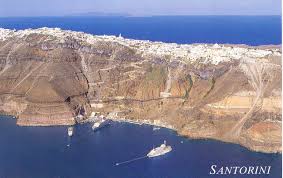
The inner coast around the caldera is a sheer precipice of more than 300 m drop at its highest, and exhibits the various layers of solidified lava on top of each other, and the main towns perched on the crest. The ground then slopes outwards and downwards towards the outer perimeter, and the outer beaches are smooth and shallow. Beach sand colour depends on which geologic layer is exposed; there are beaches with sand or pebbles made of solidified lava of various colours: the Red Beach, the Black Beach, the White Beach, etc. The water at the darker coloured beaches is significantly warmer because the lava acts as a heat absorber. The principal port is called Athinias. The capital, Fira, clings to the top of the cliff looking down on the lagoon. The major settlements include Oia, Emporio, Kamari, Perissa, Imerovigli, Pyrgos, and Therasia. Akrotiri is a major archaeological site, with ruins from the Minoan era.
Santorini is one of the few Cyclades Islands with a major airport ( we could arrive by boat and leave by plane )
Santorini  : The MICHELIN guide review
Santorini is the most spectacular of the Cyclades; arriving by boat in its ancient crater overwhelmed by the sea thousands of years ago is an unforgettable experience. The natural circle is surrounded by giant cliffs in a variety of hues resulting from their volcanic origin: black lava, purplish-grey ash, reddish clinker, and pale pumice. High above stand scarlet villages. The jumble of houses forming Thira and its surrounding hamlets is remarkable, on the edge of the caldera, which may be explored by boat.
Afficher greece sur une carte plus grande

No comments:
Post a Comment